
Jesus’ Declaration of War
The Redemption of Cosmic Corruption at the Gates of Hell

Jesus did not make this statement in a synagogue.
He said it at the gates of Hell.
Approximately six or seven months before His crucifixion, Jesus walked His disciples into one of the darkest spiritual locations in the ancient world—and made His declaration there.
The Place No Rabbi Would Choose
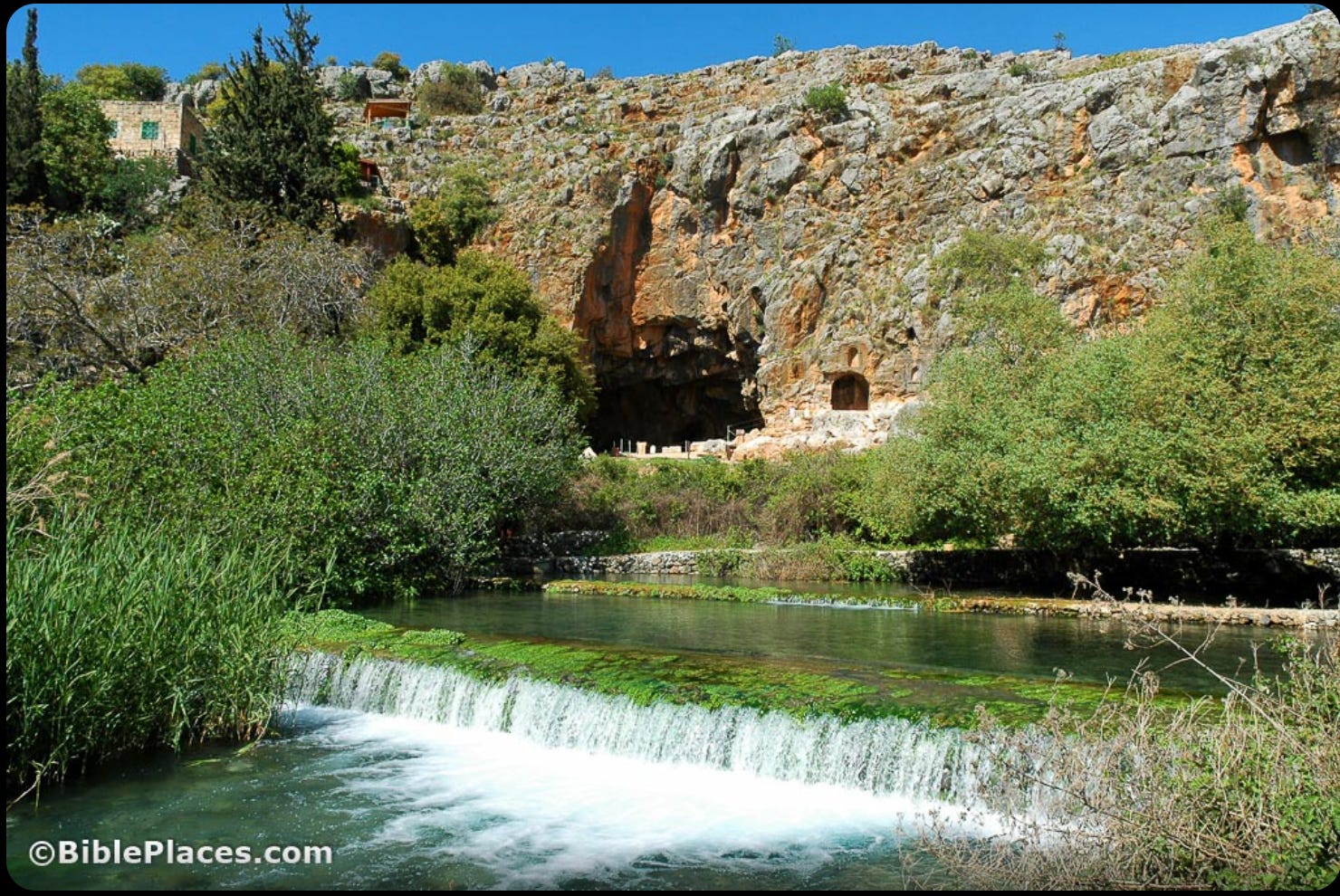
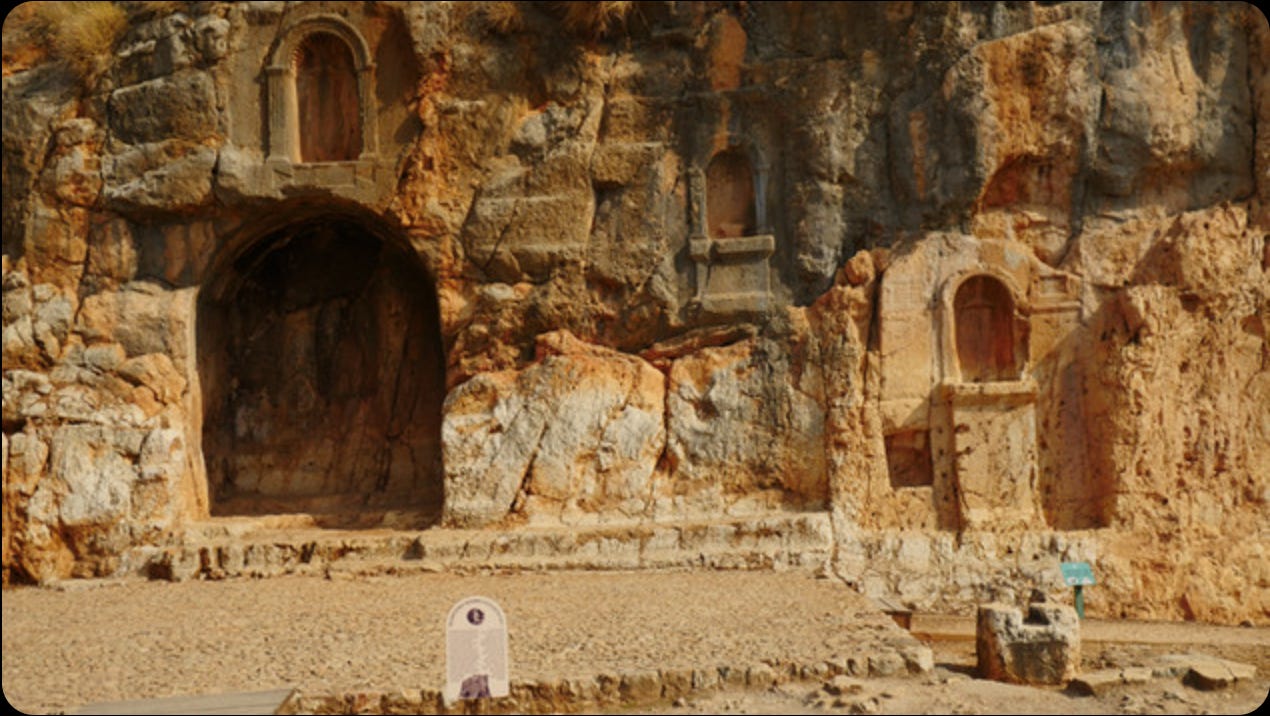
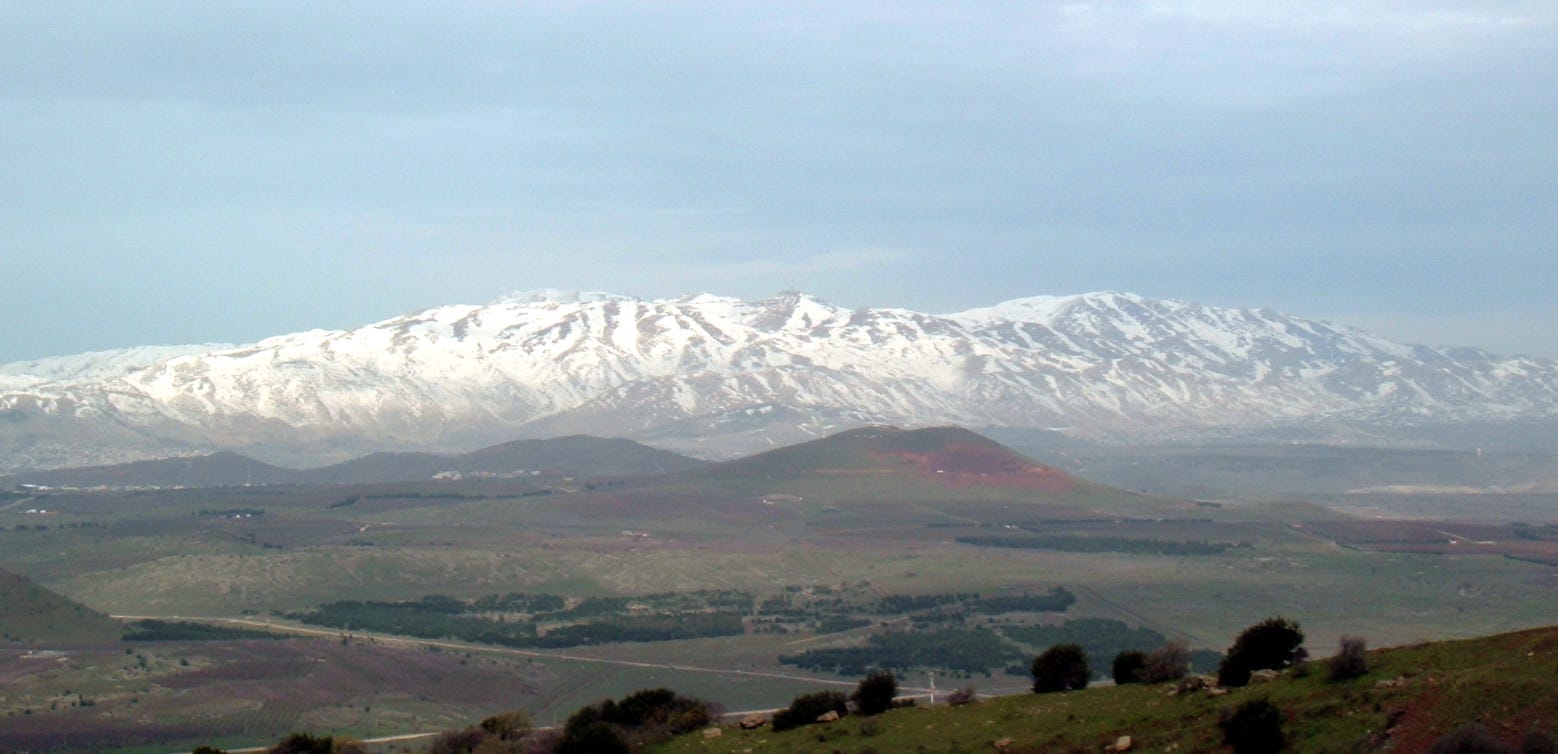
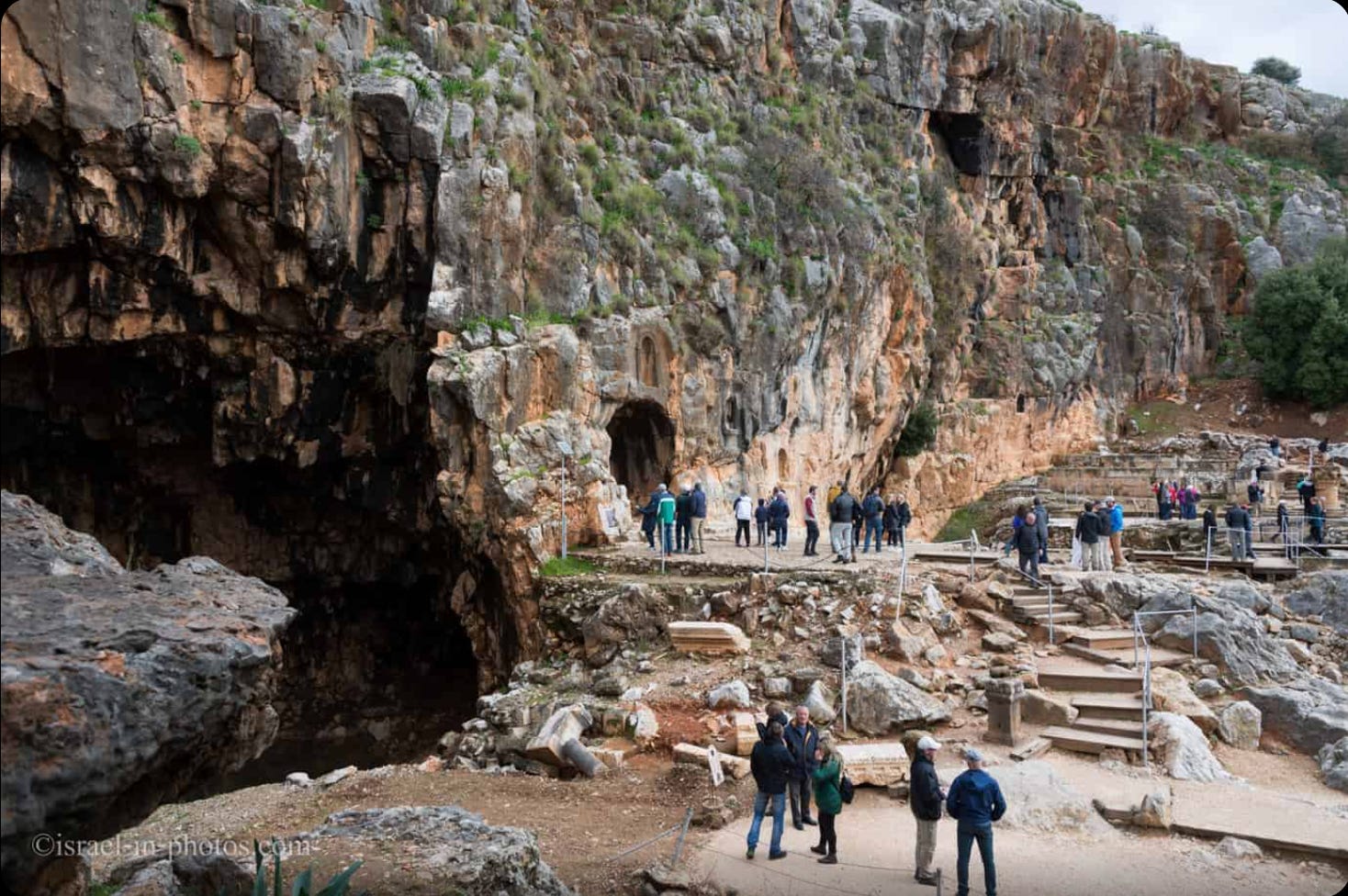
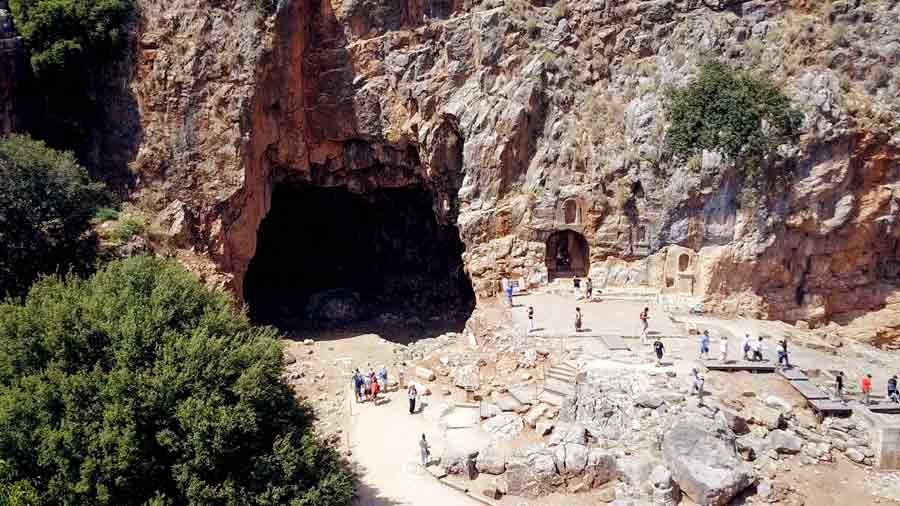
The region was Caesarea Philippi, in Bashan. At the southwest base of Mount Hermon.
A place known for:
Pagan worship and sacrifice
A temple to the god Pan—a Greek deity associated with the wild, untamed world or chaos (it’s where we get the word panic)
A massive cave believed by the ancients to be the entrance to the underworld, where sacrifices were offered into its depths
A site known as the Gates of Hades—the Gates of Hell
Jesus brings His disciples here. Not to avoid it. Not to comment on it. But to confront it.
Authors Note: To understand what’s about to take place it is extremely important to understand the context surrounding this event. Many of you have likely read this verse many times without realizing the context in which it was given. In addition to Caesarea Philippi being affiliated with the god Pan, it’s important to understand that Caesarea Philippi is located in the region of Bashan. Bashan was not a neutral region in the biblical imagination. It was known as the land of the Rephaim—the ancient giants—ruled by Og, described as the last of his kind (Deuteronomy 3:11). These figures became associated with the broader memory of rebellion against God, often linked conceptually to Genesis 6 traditions and the rise of hostile powers. Theologically, Bashan came to represent more than geography—it was a landscape marked by opposition. Psalm 68 even portrays it as a rival mountain, set in contrast to Zion itself (Psalm 68:15–16). In other words, it was a place long associated with defiance, power, and the enemies of God.
Why Mount Hermon Matters
Mount Hermon is not just a geographical detail. In Hebrew, Hermon (חֶרְמוֹן – ḥermōn) is widely connected to the root חרם (ḥerem)—a word used throughout the Old Testament for something devoted irrevocably to God, often through judgment.
It is the language of:
Things placed under the ban
Things set apart permanently
Things given over to destruction (Joshua 6; Leviticus 27:28)
This is not ordinary holiness. This is something set apart in a final, irreversible way.
Which means Hermon can carry the sense of a place marked for divine reckoning.
And in Second Temple Jewish thought, Hermon was remembered as the place where the Watchers descended and rebelled. A place where heaven’s order was violated. A place associated not with faithfulness—but with cosmic corruption.
So Jesus doesn’t just take them somewhere dark. He takes them somewhere where iniquity was rife, a place long associated with the rebellion of the Watchers.
Who Do People Say That The Son Of Man Is?
Standing in that place, He asks:
“Who do people say that the Son of Man is?”1
The apostles respond:
John the Baptist.
Elijah.
Jeremiah.
One of the prophets.
Then He turns the question toward them:
“But who do you say that I am?”2
Not in safety. Not in abstraction. But at the edge of what people in the Ancient Near East believed was the realm of the dead.
The Confession That Cuts Through the Darkness
Peter answers:
“You are the Christ, the Son of the living God.”3
That word matters.
Living.
Because all around them were altars to gods that did not speak…
did not act…
did not live.
Dead gods. Silent gods. Powerless gods.
And in that place—at the mouth of death itself—Peter declares: The living God is standing here.
What Jesus Says Next Changes Everything
Jesus responds immediately:
“Blessed are you, Simon Bar-Jonah! For flesh and blood has not revealed this to you, but my Father who is in heaven.”4
That opening line is easy to pass over.
It shouldn’t be.
“Simon Bar-Jonah.”
In the ancient Jewish world, a name was never just a label. It was identity. To be called “son of” someone was to be defined by them—your origin, your place, your inheritance, your frame of reference. Your father told the world who you were.
So when Jesus says “Bar-Jonah”—son of Jonah—He is doing something precise.
He is grounding Peter in his human identity.
And then, in the very next breath, He contrasts it:
“Flesh and blood has not revealed this to you, but my Father who is in heaven.”5
The contrast is the point.
You are the son of Jonah by birth. But what you just said…
That did not come from your father.
It came from mine.
For a moment, Peter is standing in a different line of knowing.
A different source.
A different family of revelation.
Two Ways of Knowing
Jesus draws a hard line here—one that most people miss.
There are two categories of knowledge:
Flesh and blood knowledge — what can be reasoned, studied, observed, inherited, or taught
Revealed knowledge — what the Father discloses directly
Peter did not arrive at “You are the Christ, the Son of the living God” by being smarter than the other disciples. He wasn’t more theologically educated. He wasn’t running a tighter exegetical method. The content of his confession was given to him.
What This Means for Faith
This is one of the most underappreciated statements in the entire New Testament. Because it reshapes how we understand belief itself. You cannot reason someone into this confession.
You can explain.
You can argue.
You can teach.
But you cannot produce it. Because at its core, saving knowledge is not discovered—It is revealed.
And in that moment, standing at the gates of death, Peter does not discover truth…
He receives it.
The Rock—What Jesus Actually Said
In Matthew 16:18, Jesus responds:
“And I tell you, you are Peter, and on this rock I will build my church, and the gates of hell shall not prevail against it.”6
This is not repetition. This is precision. Two different words. Two different meanings.
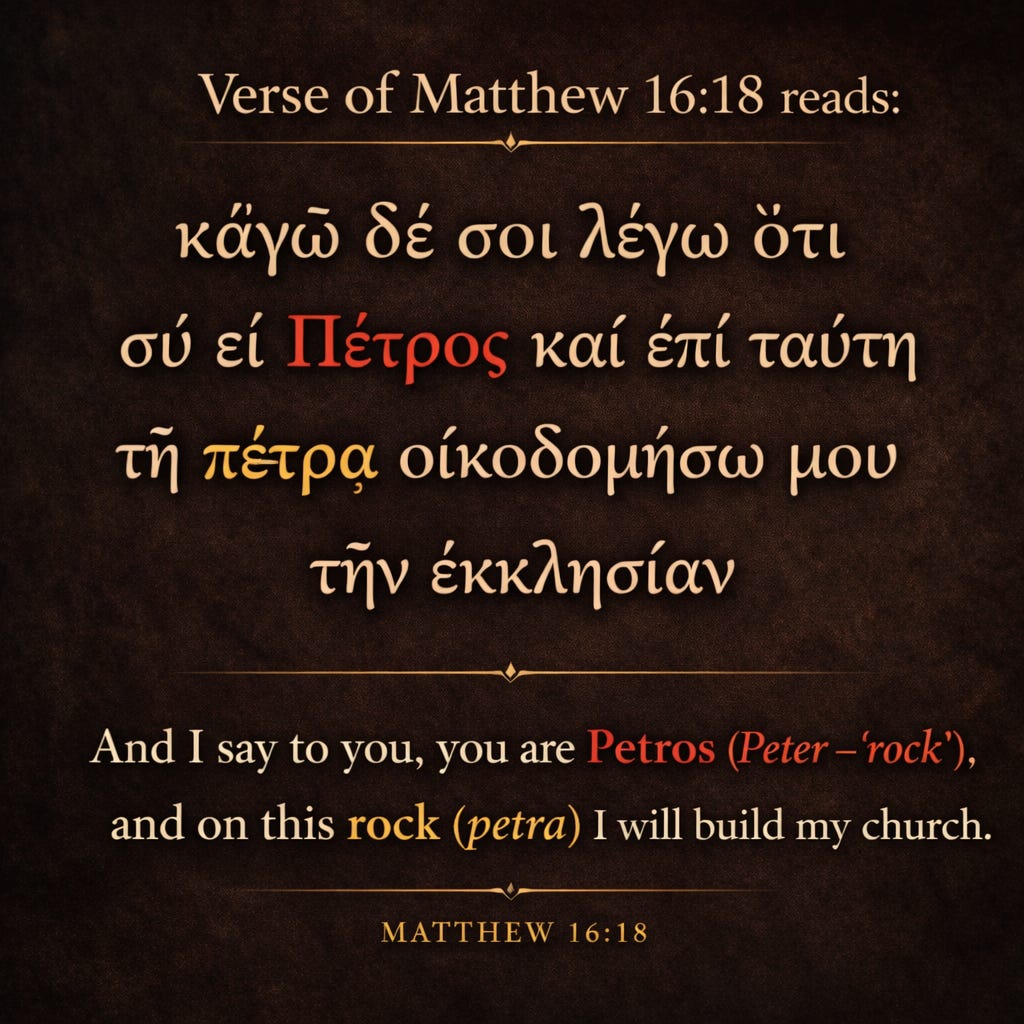
Here is where an English translation of the Bible robs you of the richness and wordplay of the Greek. Jesus says, “You are Petros (Πέτρος), and upon this petra (πέτρα) I will build my church.”
This is one of the most debated phrases in all of church history, and the debate itself is instructive.
The two words are related but distinct. Petros is masculine and typically refers to a movable stone or a piece of rock, i.e., a boulder you could throw. Petra is feminine and refers to bedrock — the massive, immovable foundation stone, the living rock beneath the surface.
Jesus gives Simon the name Petros — a stone, a rock-man. Then he says the church will be built on petra — bedrock.
The Catholic tradition reads this as Jesus declaring Peter himself to be the foundation of the church — the first pope, the source of apostolic succession.
The Protestant tradition has generally countered that the petra refers either to Peter’s confession (you are the Christ — that truth is the bedrock) or to Christ himself as the true rock (1 Corinthians 10:4, 1 Peter 2:8).
Jesus is not doing one thing here — he is doing several simultaneously:
1. He is renaming Simon. The act of renaming in the Old Testament always signals transformation and new vocation — Abram to Abraham, Jacob to Israel, Saul to Paul. Simon is being made into something. He is becoming Petros — a rock-man, formed for a purpose.
2. He is building his church on something that Peter’s confession has pointed to — namely, the identity of Jesus himself as the Christ, the Son of the living God. The petra is not Peter’s personality or his authority in isolation; it is the revealed truth that Peter has just spoken. That Jesus is the living God!
3. He is giving Peter a genuine, irreplaceable role. Peter is not incidental to what follows. He will preach the first sermon at Pentecost. He will be the first to take the gospel to the Gentiles (Acts 10). He will write two epistles that will anchor the church’s theology of suffering and holiness. The commission here is real.
The critical insight is that petra and Petros are related but not identical. Peter is a stone—formed from the bedrock, but not the bedrock itself. Christ is the cornerstone (Ephesians 2:20) and the bedrock is the revealed truth about who Christ is.
In the 24 hours leading up to the crucificition, Peter will deny Jesus three times. The petra doesn’t crack when Petros does — and that is the point.
The Gates of Hell Shall Not Prevail
This phrase is almost universally misread, and the misreading has had catastrophic consequences for how Christians understand their mission.
The popular reading is defensive: The church is under siege from hell, but don’t worry — the gates will hold. The church as a bunker. The church as a fortress pulling up the drawbridge against the demonic onslaught.
This reading gets the image exactly backwards.
Gates do not attack. Gates defend. Gates are stationary.
Gates are the defensive architecture of a city. When Jesus says the gates of Hell (or Hades) will not prevail against the church, he is describing a scene where the church is the advancing army and Hades is the fortified city under siege. The church is marching on the gates of death — and those gates will not hold.
This is a military image of conquest, not survival.
The word Hades (ᾅδης) in the first-century Jewish and Greek imagination referred to the realm of the dead — the place where the dead go, the underworld, the domain of death’s authority. The “gates of Hades” would have been understood as the entrance to that realm, the boundary between the living and the dead, the lock on death’s prison.
Jesus is standing there on enemy ground and announcing:
Death’s domain will be breached
Its authority will be broken
Its captives will not remain
Because in a matter of months—He will go there Himself, free Abraham’s bosom and march past the 200 watchers imprisoned in Tartarus. Then He will come back out.
This reframes everything about mission:
The church does not huddle together hoping the culture doesn’t overwhelm it. The church moves into the culture precisely because death’s kingdom has no gate strong enough to stop it.
Evangelism is not recruiting people to a safe community. It is pulling people out of a kingdom that is already losing its structural integrity because the King has already broken through it himself (cf. Revelation 1:18 — “I hold the keys of Death and Hades”).
The resurrection of Jesus was the first breach of the gate. The church, animated by the same Spirit, is the ongoing siege operation.
Jesus chose this spot to make this declaration. He is standing at the enemy’s front door—and announcing the collapse of its gates.
The Transfiguration
Matthew writes:
“And after six days Jesus took with him Peter and James, and John his brother, and led them up a high mountain by themselves.” 7
They are already at the base of Hermon. And now they go up.
On that mountain:
Jesus is transfigured
His face shines like the sun
Moses and Elijah appear
The Father speaks
This is not just revelation.
This is reclamation.
The place remembered for rebellion…
Now becomes the place where the Son is revealed in glory.
What was once associated with defilement…
Now becomes holy ground.
Final Reflection
Jesus did not avoid the darkest places. He walked directly into them. And announced their end. The question is not whether He is advancing.
The question is whether you recognize it—and whether you are standing with Him when He does.
If You Want to Go Deeper
If this moment in Matthew 16 feels bigger than you were ever taught… that’s because it is.
This is not an isolated scene.
It is part of a pattern that runs through Scripture—one that stretches from Genesis… through the Psalms… and into the book of Hebrews.
A pattern where God was already revealing His plan long before the cross.
That’s exactly what I explore in Melchizedek: The Mysterious Priest-King Three Verses That Unveil God’s Redemptive Plan.
How those three passages, written over two thousand years apart, form one unified message about who Christ is and what He came to do.
If you’ve ever wanted to read the Bible not just for stories—but for the structure underneath them, that’s where to start.
Adam Dougherty is the Author of Melchizedek: Myterious Priest-King Three Verses That Unveil God’s Redemptive Plan.
Matthew 16:13 (ESV).
Matthew 16:15 (ESV).
Matthew 16:16 (ESV).
Matthew 16:17 (ESV).
Matthew 16:17 (ESV).
Matthew 16:18 (ESV). The NASB 2020 refers to it as “the gates of Hades.”
Matthew 17:1 (ESV).
Wow! What a fantastic article. A great read to start the day off right.
The gates of Hell will not hold….